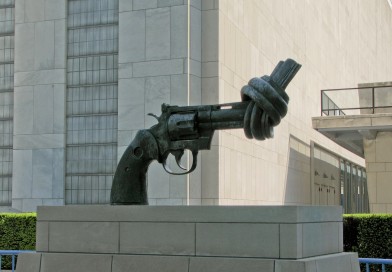
Are killing-free societies possible? Evidence suggests that by working with committed organizations, leaders and individuals like you we can signficantly reduce and eventually eliminate human killing. This goal belongs to everyone, across political, religious or ethnic affiliations. The development of truly civil societies, and nothing less than the future of humankind, depends on our joint success.

Join us today:
  • Sign the affirmation to work toward a world where human killing is stopped,
  • Take our survey on how we can work together to end killing now,
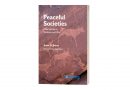
  • Download a free book to gain additional insights into creating killing-free societies, or
  • Email us your ideas.
  • Working Papers


    Working Papers


    Global Nonkilling Working Papers (ISSN 2077-141X [print]; ISSN 2077-1428 [online])

    • Issue #1 "Are Humans Inherently Killers?" A Critique by Robert Sussman and Joshua Marshack Followed by a Response by Richard Wrangham

      pdf Download in PDF. Support independent publishing: buy this book on Lulu. Order hardcopies from Lulu

    • Issue #2 "Examining Domestic Violence as a State Crime: Nonkilling Implications" By Laura L. Finley

      pdf Download in PDF. Support independent publishing: buy this book on Lulu. Order hardcopies from Lulu

    • Issue #3 "Nonkilling Global Political Science: A Critical Evaluation" By Balwant Bhaneja, Joám Evans Pim, Piki Ish-Shalom, Chaiwat Satha-Anand and Yoon-Jae Chung

      pdf Download in PDF. Support independent publishing: buy this book on Lulu. Order hardcopies from Lulu

    • Issue #4 "Socioeconomic Democracy: A Nonkilling, Life-Affirming and Enhancing Psycho-Politico-Socio-Economic System" By Robley E. George

      pdf Download in PDF. Support independent publishing: buy this book on Lulu. Order hardcopies from Lulu

    The Center for Global Nonkilling launched in January 2010 its Global Nonkilling Working Papers series. Following the Center’s mission of “promoting change toward the measurable goal of a killing-free world”, the series are dedicated to theory and research incorporating original scientific works that tackle issues related to the construction of nonkilling societies, where killing, threats to kill and conditions conductive to killing are absent. The Global Nonkilling Working Papers series have a multidisciplinary perspective, open both to theoretical and empirical works on topics such as:

    • Nonkilling and neuro-bioscience
    • Nonkilling and gender relations
    • Nonkilling and education
    • Nonkilling and economics
    • Nonkilling and the environment
    • Nonkilling and the media
    • Nonkilling, science, and technology
    • Nonkilling in spiritual and philosophical traditions
    • Nonkilling and the arts
    • Nonkilling and sports
    • Nonkilling and the professions
    • Role of the military and police in nonkilling social transformation
    • Nonkilling futures
    • Nonkilling and leadership

    A wider list of possible research topics can be found in the two following publications: Nonkilling Global Political Science (2002; 2009) by Glenn D. Paige and Toward a Nonkilling Paradigm (2009), edited by Joám Evans Pim. Both available for free download at the Center's website.

    The collection is published on an occasional basis as texts are delivered by authors and reviewed by the Nonkilling Research Committees. The series will be distributed both on print and online, all issues being available for free download through the Center’s website. Authors remain as sole holders of the legal copyright for their texts, but a Creative Commons Attribution-Noncommercial-No Derivative Works 3.0 will be applied through the series to guarantee wide distribution and fair educational use.

    Authors must submit a title, a 100 word summary and a 80 word biographical sketch, prior to acceptance of the complete proposal. After approval, authors will have four months to complete the final text, with an extension between 10,000 and 20,000 words. The Chicago Manual of Style should be used for reference.

    For additional information contact series Editor Joám Evans Pim.